2026-02-21 | GeometryOS | Research
Neuralangelo (NVIDIA, 2023): From 2D Video to Detailed 3D Scenes
A technical analysis of NVIDIA's Neuralangelo (2023), evaluating hash-grid architecture and numerical gradients for deterministic 3D production pipelines.
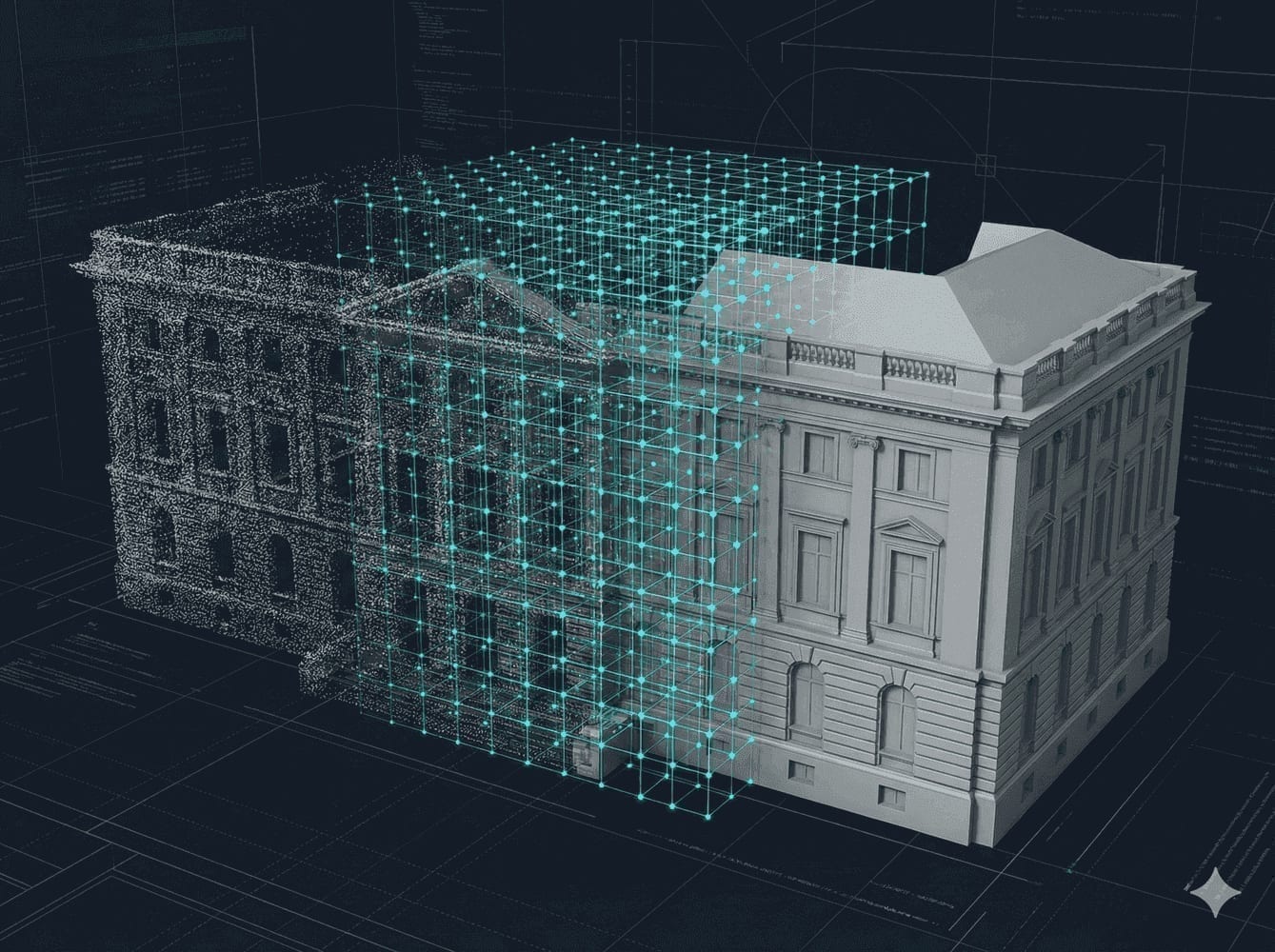
Neural surface reconstruction evolved from research to production relevance when NVIDIA introduced Neuralangelo in 2023. The framework addressed a key bottleneck in NeRF pipelines: extracting high-fidelity, manifold surfaces that can be used in simulation and traditional rendering workflows.
Neuralangelo combines multi-resolution hash encodings with Signed Distance Functions (SDFs), turning monocular video into mesh-ready geometry. For pipeline engineers, the value is not novelty. The value is deterministic geometry behavior, controllable smoothing, and better surface continuity.
Time context
- Source published: 2023-06-18 (CVPR 2023)
- This analysis published: 2026-02-21
- Last reviewed: 2026-02-15
Numerical gradients as the core breakthrough
A major limitation of standard hash-grid gradients is locality. Analytical gradients at point x depend on only nearby cell corners, which can produce noisy surfaces and weak global smoothness.
Neuralangelo addressed this with finite-difference numerical gradients:
By selecting \epsilon relative to grid resolution, updates spread across multiple cells. This improves global adherence to the Eikonal constraint:
In practice, this is the difference between noisy geometry and smooth, production-usable surfaces.
Deterministic coarse-to-fine optimization
Neuralangelo uses a predictable optimization schedule:
- Warm-up phase: activate coarse levels to recover volume and silhouette.
- Detail activation: reduce
\epsilonand progressively enable finer levels. - Curvature control: apply and decay curvature regularization as detail increases.
For production teams, this enables early validation checkpoints. If coarse geometry is wrong, runs can be terminated before expensive fine-detail stages.
Production constraints
| Criterion | Requirement or Limitation |
|---|---|
| GPU VRAM | 24 GB recommended for default-quality runs |
| Pose quality | High SfM/COLMAP accuracy required |
| Materials | Reflective/specular surfaces remain difficult |
| Capture | High shutter speed is important to limit blur |
A common failure case in industrial capture is polished material. Reflections can be interpreted as geometry and create pits or missing regions.
What changed after 2023
- 3D Gaussian Splatting (3DGS) improved rendering speed but does not natively provide manifold meshes for simulation workflows.
- 2D Gaussian variants improved surface alignment, but mesh extraction quality is still pipeline-dependent.
- ProbeSDF-style methods preserved SDF strengths while improving training efficiency.
SDF-based approaches remain valuable where geometric integrity matters more than pure render speed.
Industrial digital twin and FEA path
A common production flow:
- Capture monocular video (handheld or drone).
- Reconstruct dense mesh with Neuralangelo.
- Retopologize to simulation-friendly quads.
- Export to FEA stack for stress or deformation analysis.
This is where deterministic surface quality directly impacts engineering outcomes.
Practical guidance
- Use ROI validation before long training runs.
- Keep hardware budgets realistic. Quality drops quickly when aggressively downscaling for small VRAM.
- Improve pose estimation with mixed captures, including high-quality stills.
Neuralangelo remains relevant because it prioritizes geometric truth. Even with faster alternatives, deterministic SDF reconstruction remains a strong production choice when mesh quality is a hard requirement.
See Also
Continue with GeometryOS