2026-02-11 | GeometryOS | Research
Text-to-3D Shape Generation STAR Report: How Far Did We Get by 2024
A technical review of the 2024 STAR report on text-to-3D, mapped to production constraints like topology quality, reproducibility, and validation gates.
The 2024 STAR report on text-to-3D clarified how quickly the field advanced and why production adoption remains difficult. It documented major gains in semantic generation, but also exposed persistent issues in topology quality, repeatability, and pipeline safety.
Time context
- Source published: 2024-04-26
- This analysis published: 2026-02-11
- Last reviewed: 2026-02-11
What changed since 2024
Since the report, the ecosystem moved toward faster reconstruction-oriented systems and stronger hardware-integrated workflows. Even so, the core production gap remains: generated outputs are often visually plausible but technically unstable for deterministic pipelines.
Three supervision families from the STAR taxonomy
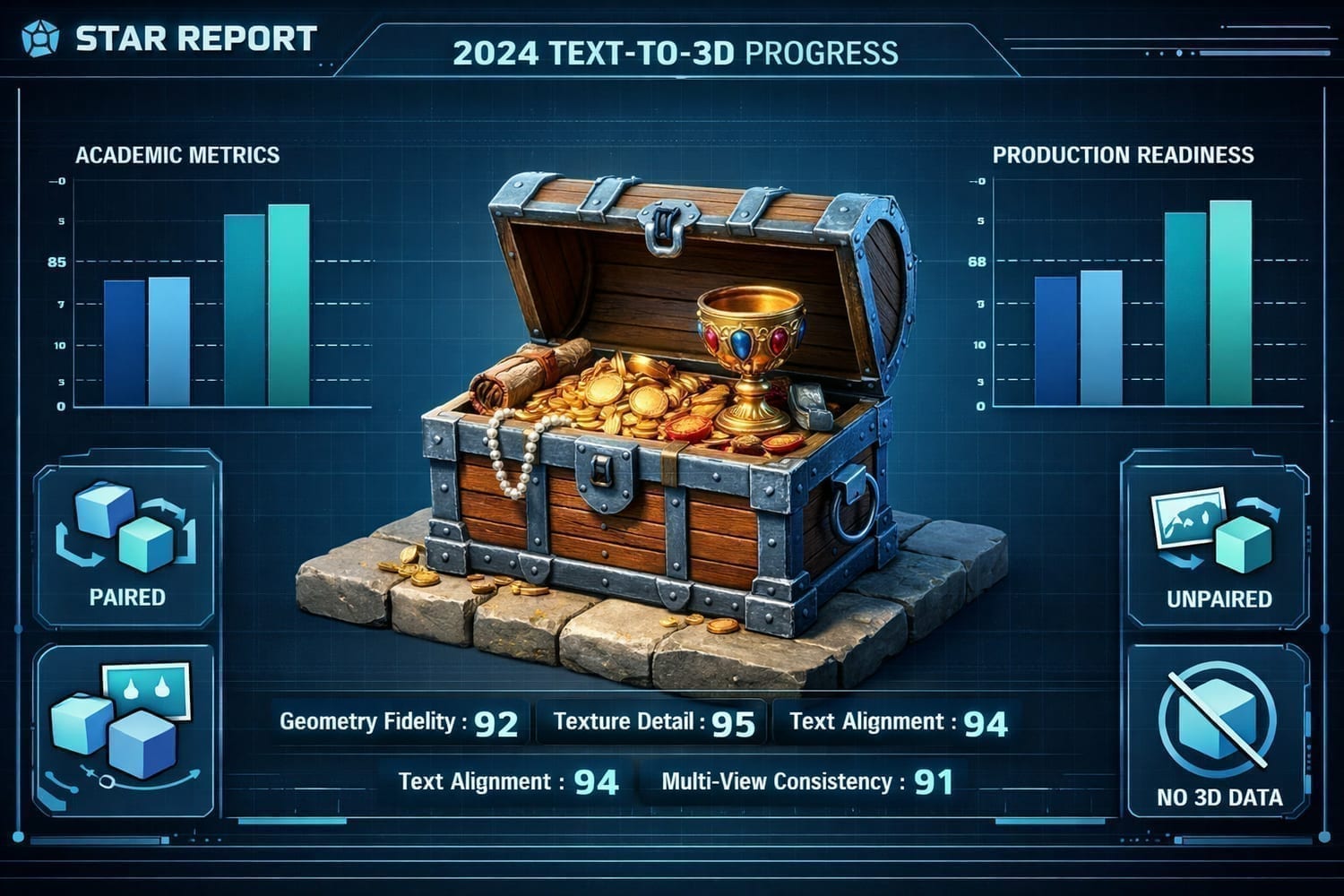
The report frames text-to-3D systems into three strategic families:
- Paired text-to-3D supervision
- Unpaired 3D supervision with language-vision alignment
- No-3D-data approaches that lift 2D priors into 3D optimization
Each family improves one axis while compromising another (data requirements, quality stability, or runtime cost).
Representation choice still determines pipeline risk
| Representation | Typical benefit | Pipeline concern |
|---|---|---|
| Voxels | Simpler modeling assumptions | Poor scaling at high fidelity |
| Point clouds | Efficient sparse representation | No native connectivity |
| NeRF-like fields | Strong view realism | Harder downstream editability |
| SDF/mesh outputs | Better tool compatibility | More fragile optimization |
The practical implication: representation strategy is an infrastructure decision, not just a model detail.
Evaluation gap: academic metrics vs production readiness
A system can score well on generative metrics and still fail real production. Teams need release gates for:
- Topology integrity
- UV and material consistency
- Scene/asset scale correctness
- Stable rerun behavior
Without these gates, teams incur heavy manual cleanup and non-deterministic delivery risk.
Deterministic production guidance
To operationalize text-to-3D responsibly:
- Build validation as a first-class stage, not post-hoc cleanup.
- Track reproducibility and drift across reruns.
- Normalize scale, pivots, and structural rules before integration.
- Require pipeline-safe export criteria before publishing assets.
For broader context, review related posts on /blog/ and baseline concepts in /faq/.
Summary
By 2024, text-to-3D achieved a major capability milestone, but not full production replacement. The decisive factor for adoption is the production layer that enforces determinism, validation, and repeatable pipeline behavior.
See Also
Continue with GeometryOS